
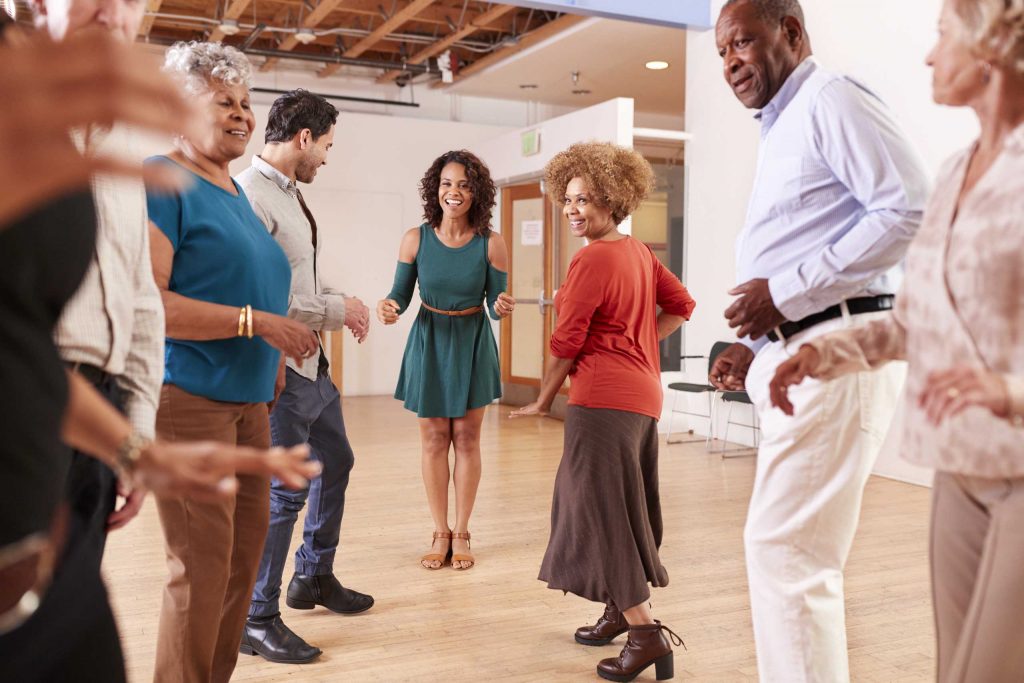
A big part of learning a skill is how you maintain the ability to do it over time. If you are only dancing with yourself, you aren’t actually practicing connection. Connection isn’t just about holding hands, it’s about timing, it’s about focus, it’s about intent. When you’re connected to someone else, you’re not practicing a step in a vacuum. The step now has to fit within a system, and that system is constantly adapting to circumstance.
Learning how to adapt consistently regardless of circumstance is a major component of sustainable skill building. You can practice the mechanics of a movement alone until the cows come home, but that doesn’t teach you how to adapt to changing circumstances. When you’re connected to someone else, every dance is different, every moment is different. You have to adjust to each subtle variation, and that keeps your nerves and muscles from calcifying into a habituated pattern of movement. Your skills last longer because they aren’t locked into a specific circumstance. They are adaptive by their nature.
We find it’s really easy to focus on the big ticket items like patterns and movements when we’re learning, but connection affects even the small stuff. In particular, connection means shared responsibility. You don’t have to pay attention to everything yourself. That’s a relief. It reduces a lot of the mental strain that comes from dancing, and it frees your body up to do what it does best. When you’re learning while sharing responsibility for everything, you naturally relax more and your body coordinates itself more easily. And over time that starts to feel like less effort to move even as you’re learning more complex movements. That’s a huge part of sustainable progress in dance.
The other piece that connection plays into is error correction. When you’re practicing by yourself, you might not notice that you’ve messed something up until after the fact. When you’re dancing with a partner, you’ll feel an error the moment it happens. A moment of losing balance, a fraction of a second of hesitation, a brief disruption in flow. All of these signal to you that you need to correct something. It creates a feedback loop that allows you to correct yourself in the moment. You don’t need someone to explain what went wrong. You can just feel it, and you learn how to correct it through body awareness.
There’s also an emotional component to connection. When you’re learning with a partner, the reward isn’t just about mastering a new skill. It’s about having a better dance. It’s about communicating more effectively. It’s about being comfortable and confident in your ability to connect and move together. It’s not about impressing other people with what you know, it’s about improving your connection and your ability to communicate with the people you dance with. And that makes learning feel less transactional. It’s not about building up this pile of moves in your head. It’s about engaging in a process with other people. Even when you reach a plateau, where you’re not learning as much, you still enjoy engaging in the process. That’s what connection does for your learning. It turns it into a process, rather than an accumulation.