
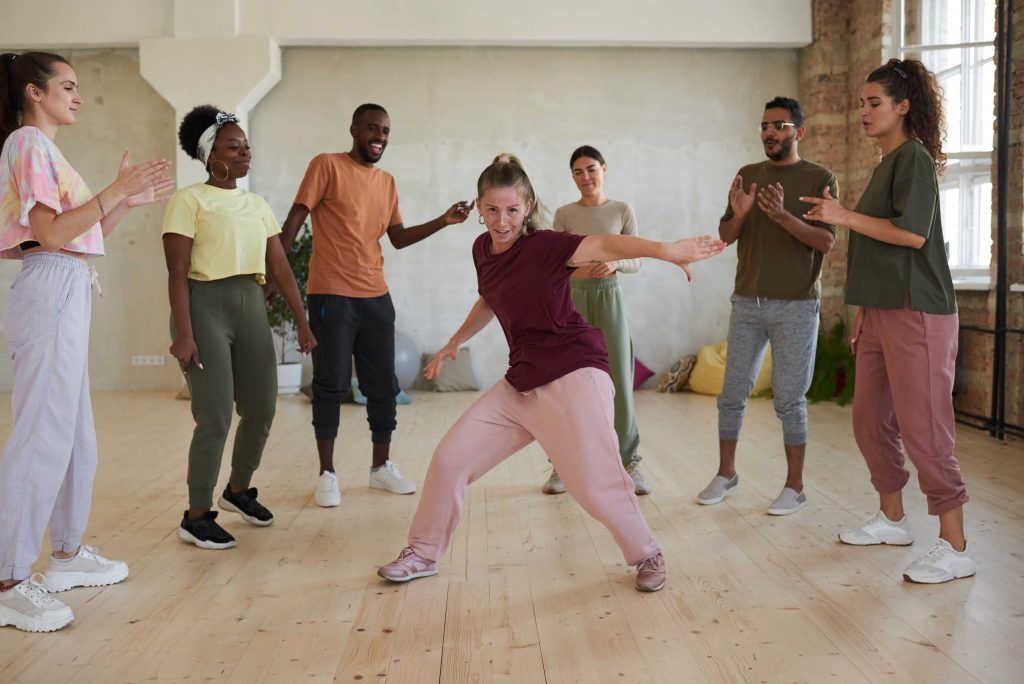
In most educational situations, it’s common for improvement to manifest as adding more movements, techniques and variety. This is where social dancing breaks that mold and shows us why we make faster progress when we simplify. By stripping away non-essential movements, our focus is magnified. The body doesn’t have to divide its attention among many details and consequently, our coordination, timing and balance organize themselves faster. Simplicity isn’t a hindrance to improvement; it’s a catalyst for it.
When we introduce complexity too quickly, it’s easy to overlook fundamental flaws. The movement may look flashy enough to distract us from our unstable posture or our unclear timing. Simplicity doesn’t permit us to ignore our faults like that. Basic movements will reveal our posture, our weight transfer and our connection with absolute clarity. That isn’t a bad thing; it’s diagnostic. When we have fewer variables to deal with, it’s easier to distinguish what we need to work on instead of adding band-aids on top of our problems.
Furthermore, simplicity helps us develop repeatability. Basic patterns are easier to repeat under any circumstance and once we can achieve that, our sense of mastery will sky-rocket. Progress isn’t just about learning something new. It’s about feeling like we can repeat what we learned anywhere, anytime. Simplicity gives us that kind of confidence. It also gives us musicality. We can’t be musical when we’re trying to execute complex patterns.
When we strip those away, our body responds more directly to the rhythm and phrasing of the music. Our dancing actually starts to reflect the qualities of the music instead of simply playing in the background. That yields expression, without any extra effort on our part. We don’t have to learn more to be musical, we just have to listen more. Our musicality comes from our timing and dynamics, not our decorations.
Finally, simplicity changes the way we perceive improvement. We measure our progress by clarity, ease and versatility instead of quantity. This takes much of the frustration out of our practice because it encourages us to be patient. Progress comes in layers and each one builds upon the last. When we finally introduce complexity into our dance, we can handle it because we have a solid foundation to fall back upon. In that way, simplicity ceases to be a restriction and becomes the fastest way to achieve mastery.