
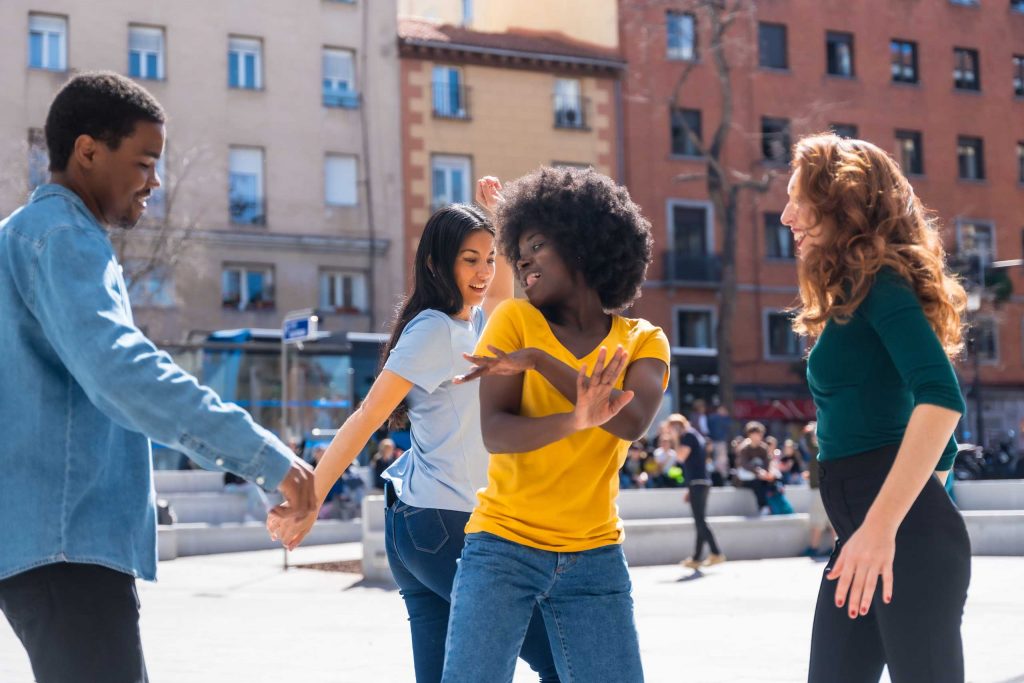
It is more accurate to say it is a language of movement, rhythm and focus that must constantly adjust to the present moment. Social dance does not teach technique first and awareness second. It does the opposite. It teaches you to respond, not react. It teaches you to listen before you move. It teaches you to move from intention rather than force. And this changes everything about how you learn to move and how you experience progress.
Social dance provides instant feedback for every single movement you make. Because you are dancing with other people, the moment you step on someone’s foot or throw them off balance, you will know about it. Similarly, the instant you nail a rhythm or phrase, you will feel it working. There is no opportunity to ignore your technique or pretend it is better than it is. You get instant physical feedback in real-time, every time you make a movement. You don’t learn how to adjust through visual cues or verbal corrections so much as you learn through your own kinesthetic sense of the movement. Over time, this process will help you develop a sense of good movement that will feel solid however many different people you dance with, however good or bad the music may be.
Music is a fundamental part of social dance. It is not something you dance to. It is something you dance within. You listen for the rhythm to guide your timing. You listen to the melody to help you find the character of the movement. You listen to the space between the notes to understand when to breathe. Learning to move musically changes the way you experience rhythm and timing. You begin to develop an internal sense of rhythm so that you do not need to count music to find the beat. This will help your timing in all your activities. It will help you tune in to patterns and rhythms you were not aware of before. It will help you stay focused when you need to, and keep a sense of humor when you lose it. Your ability to feel patterns and adjust to changes in timing will develop so that you begin to anticipate changes in music and movement rather than simply reacting to them.
Improvement in social dance is not measured by the number of patterns you master. It is measured by how smoothly you can execute those patterns regardless of the situation. The best social dancers are not typically the ones who know the most patterns. They are the ones who can make even the simplest movements feel amazing to the people they are dancing with. They can play with the music and rhythm in a way that adds a level of depth and expression to the movement that is not accessible to most people. When you are learning social dance, there is no particular premium on learning a lot of moves. In fact, social dance is one of the only forms of movement where less may actually be more. So there is no incentive to push yourself too hard. You can always get better at the moves you have. You can always learn to follow or lead them more smoothly. You can always play more dynamically with the rhythm and timing. In social dance, you cannot even learn new patterns until you master the ability to execute the basic movements smoothly and efficiently. This means you do not learn social dance by piling pattern on top of pattern. You learn social dance by moving. When you approach movement in this way, you begin to experience improvement as a process of refinement rather than accumulation. And this changes everything about your experience of movement and learning.
When you make a mistake in social dance, it is not the end of the world. In fact, it is just the opposite. Mistakes are an opportunity to learn something new about someone or something. They are a chance to practice a new way of moving, a new way of leading or following. And when you approach movement as a process of discovery like this, it is amazing how much more fun you will have. And it is amazing how much more you will learn.